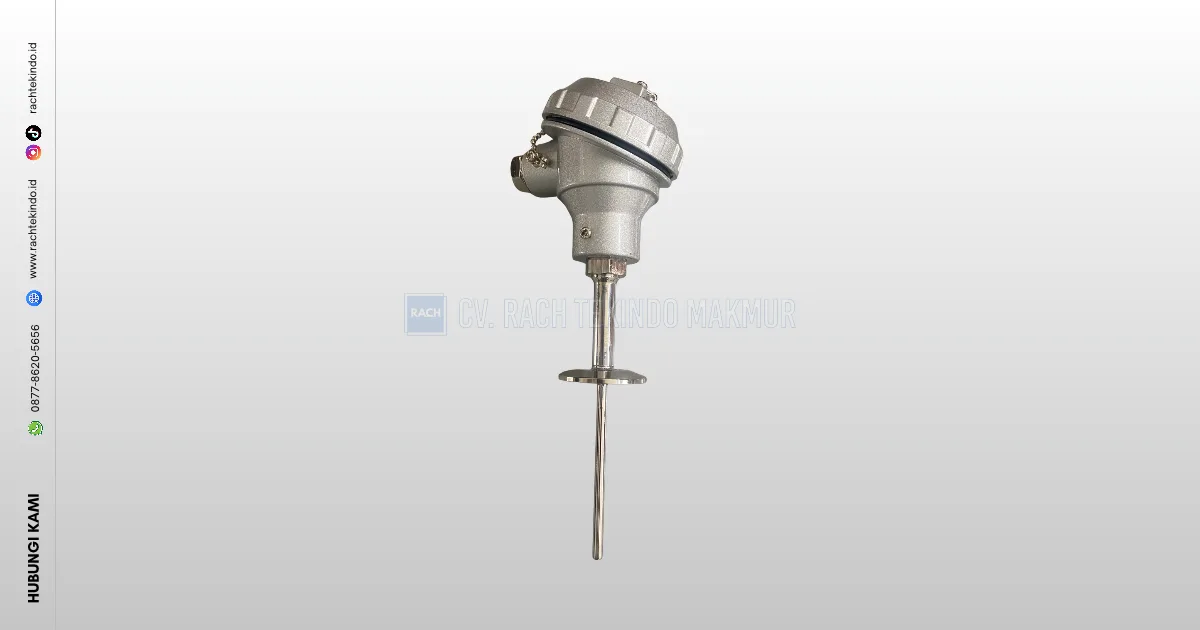
Temperature sensors and temperature transmitters are widely used in industrial monitoring and control systems. However, selecting the right product alone is not enough. Proper installation is also important because installation conditions can affect measurement quality and system stability.
A sensor installed at an unsuitable location, an incorrect connection, or a transmitter configuration that does not match the sensor can result in temperature readings that do not accurately represent the actual process condition.
Installing the Sensor at the Wrong Location
One of the most important considerations when installing a temperature sensor is the measurement location. The sensor should be installed at a point that can properly represent the temperature of the process medium.
In pipelines, for example, the sensor position should be selected according to the process flow. In tanks or vessels, sensor length and installation depth should also match the internal conditions of the equipment.
If the sensor is installed too close to a heat source, equipment wall, or another area that does not represent the actual process medium, the measurement may differ from the actual process temperature.
Ignoring the Measured Medium
A temperature sensor used for water may require a different configuration from one used for chemicals, oil, gas, or steam.
The sensor material and process-contacting components should be selected according to the characteristics of the measured medium. In certain applications, an unsuitable material can affect the sensor's ability to withstand the process conditions.
For this reason, the measured medium should always be considered when selecting a temperature sensor.
Selecting the Wrong Sensor Type
RTD Pt100, Type K Thermocouple, and Thermistor operate using different principles and have different characteristics. Selecting a sensor without considering the application requirements can result in an unsuitable measurement system.
The sensor should be selected based on the required temperature range, process characteristics, measurement requirements, and the system receiving the sensor signal.
Not every temperature application requires the same sensor type.
Using an Incompatible Temperature Transmitter
Another common mistake is using a temperature transmitter whose input does not match the installed sensor.
An RTD Pt100 requires a transmitter input compatible with RTD characteristics, while a Type K Thermocouple requires a transmitter input designed for that thermocouple type.
The transmitter measurement range should also match the process requirements. An unsuitable configuration can cause the control system to display a value that does not accurately represent the actual temperature.
Ignoring the Control System
Temperature sensors and transmitters are normally part of a larger system connected to PLC, DCS, SCADA, or a control panel.
Therefore, the required output should be determined before installation. For systems using analog inputs, 4–20 mA is one of the most commonly used outputs.
Certain applications may also require HART or RS485 communication. The transmitter should therefore be selected according to the system that will receive and process the signal.
Poor Cable Installation
Cabling is an important part of a temperature measurement system. Poor cable installation can cause signal problems or make troubleshooting more difficult.
Cable routing, terminal connections, and cable protection should be suitable for the installation environment. Proper cable organization also makes inspection and maintenance easier in industrial systems.
Not Checking the System After Installation
After the temperature sensor and transmitter have been installed, the complete measurement system should be checked before being used for full process monitoring.
The sensor connection, transmitter input, output configuration, and displayed value on the PLC, DCS, or SCADA system should all be verified.
This helps identify installation problems before they affect the production process.
Conclusion
The installation of Temperature Sensors & Temperature Transmitters requires attention to the measurement location, measured medium, sensor type, transmitter configuration, control system, and cable connections. Even a high-quality sensor requires proper installation and configuration to provide useful and reliable measurements.
Understanding the process conditions from the beginning can reduce installation errors and help the temperature monitoring system operate more reliably.
CV. Rach Tekindo Makmur provides Temperature Sensors & Temperature Transmitters for various industrial instrumentation requirements. If you need sensors, transmitters, or assistance with temperature system configuration and installation, contact us via WhatsApp at +62 877-8620-5656 to discuss your technical requirements and request a quotation based on your application.