Temperature is an important parameter that needs to be monitored in many industrial processes. Changes in temperature can affect product quality, process stability, and the condition of industrial equipment. For this reason, reliable instruments are required to measure temperature and transmit the measurement to the control system.
One commonly used solution is a Temperature Sensor & Temperature Transmitter. Although they perform different functions, both instruments work together as part of an industrial temperature measurement system.
What Is a Temperature Sensor?
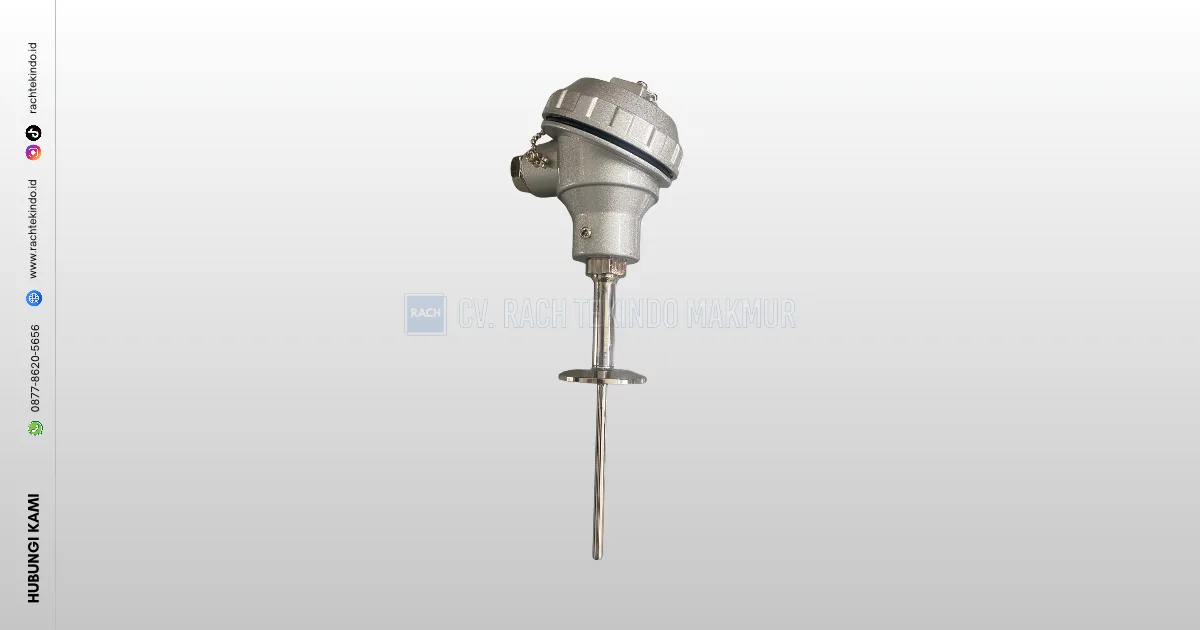
A temperature sensor is an instrument used to detect changes in temperature within a medium or process. It can be installed on pipes, tanks, boilers, heat exchangers, furnaces, production machines, and other process equipment.
Common temperature sensor types used in industrial applications include RTD Pt100, Type K Thermocouple, and Thermistor.
An RTD Pt100 operates based on changes in electrical resistance as temperature changes. A thermocouple generates a voltage signal as a result of temperature changes at the sensor junction. A thermistor also uses resistance changes caused by temperature variation, although its characteristics differ from those of an RTD.
The appropriate sensor type depends on the process conditions, measured medium, measurement requirements, and instrumentation system.
How Does a Temperature Transmitter Work?
A temperature sensor produces a signal that represents the temperature being measured. However, in industrial systems where the distance between the measurement point and the control room is relatively long, the sensor signal needs to be processed before transmission.
This is where a Temperature Transmitter is used.
The temperature transmitter receives the signal from the sensor and converts it into a standardized output such as 4–20 mA. The signal can then be transmitted to a PLC, DCS, SCADA, or another industrial control system.
For example, a temperature transmitter can be configured with a specific measurement range. Within that range, 4 mA can represent the lowest temperature while 20 mA represents the highest temperature. The control system interprets the change in current as a change in temperature.
This allows operators to monitor process temperature from the control room without taking measurements directly at the sensor location.
Temperature Sensors and Transmitters in Industrial Applications
Temperature sensors and transmitters are used in many industrial processes. In a boiler, for example, a temperature sensor can be installed to monitor operating temperature during the heating process. The sensor signal is then transmitted through the temperature transmitter to the control system.
In a heat exchanger, temperature measurement can be used to monitor the condition of the process medium before and after heat transfer. In tanks and pipelines, temperature sensors can be used to monitor the temperature of liquids or gases being processed.
Similar applications can be found in oil & gas, chemical, petrochemical, power plant, food & beverage, pharmaceutical, and manufacturing industries.
Why Is a Temperature Transmitter Needed?
In a simple installation, a temperature sensor may be connected directly to a measuring device. In more complex industrial systems, however, a transmitter provides a practical way to convert the sensor signal into a standardized output that can be integrated with the control system.
The 4–20 mA output is widely used in industrial instrumentation. Some temperature transmitters can also provide communication options such as HART or RS485, allowing them to be integrated into more advanced monitoring and control systems.
Temperature transmitters are also available in different mounting configurations, including head-mounted, rail-mounted, and field-mounted versions, depending on the installation requirements.
Selecting the Right Temperature Sensor and Temperature Transmitter
Temperature sensors and transmitters should be selected according to the actual application rather than based solely on the product type. Process temperature, measured medium, installation location, control system, required output, and environmental conditions should all be considered.
RTD Pt100, for example, is commonly selected for applications requiring the characteristics associated with RTD temperature measurement. Thermocouples are suitable for applications based on thermoelectric sensing, while thermistors are used in applications where their specific characteristics are appropriate.
The temperature transmitter should then be selected according to the sensor input, measurement range, output signal, mounting configuration, and control system receiving the signal.
Conclusion
Temperature Sensors & Temperature Transmitters are important components of industrial temperature measurement systems. The temperature sensor detects temperature changes, while the temperature transmitter processes the sensor signal and converts it into a standardized output for transmission to the control system.
With the right sensor and transmitter configuration, temperature measurements can be integrated into PLC, DCS, SCADA, and other industrial automation systems for process monitoring and control.
CV. Rach Tekindo Makmur provides Temperature Sensors and Temperature Transmitters for industrial applications. For assistance in selecting the appropriate sensor, transmitter, or configuration for your process, contact WhatsApp +62 877-8620-5656.