How to Select a Magnetic Float Level Switch Model LLS
By Admin
Read more
Liquid level control is an important part of industrial tank operation. Excessive filling can disrupt a process, while an insufficient liquid supply can interrupt downstream equipment. To identify when a liquid reaches a defined limit, operators need an instrument that sends a clear signal to the control system. The Magnetic Float Level Switch Model LLS is designed for this type of point level detection.
Rather than continuously displaying the height of liquid inside a vessel, the Model LLS detects whether the liquid has reached a selected switching point. This information can indicate a low level condition, a normal filling limit, or a high level requiring operator attention. Its contact output can then be used by an alarm circuit or an automatic control system.
The working principle combines buoyancy with magnetic switching. A float follows the movement of the liquid surface as the level rises or falls. When the float reaches a designated detection position, its magnetic field actuates an electrical contact. The resulting change in contact state tells the connected control circuit that the specified level has been reached.
The magnetic switching mechanism does not require an external power supply to move the float or actuate the contact. However, this does not mean the entire installation operates without electricity. Connected alarms, control panels, and other receiving devices still require an appropriate power supply. Understanding this distinction helps engineers define the electrical interface correctly.
A float level switch also serves a different purpose from a continuous level transmitter. A transmitter is selected when a process needs an ongoing level reading across a measurement range. A point level switch is suitable when the main requirement is a defined switching event, such as stopping a filling sequence or generating a low level alarm. Some applications may use both instruments for separate monitoring and control functions.
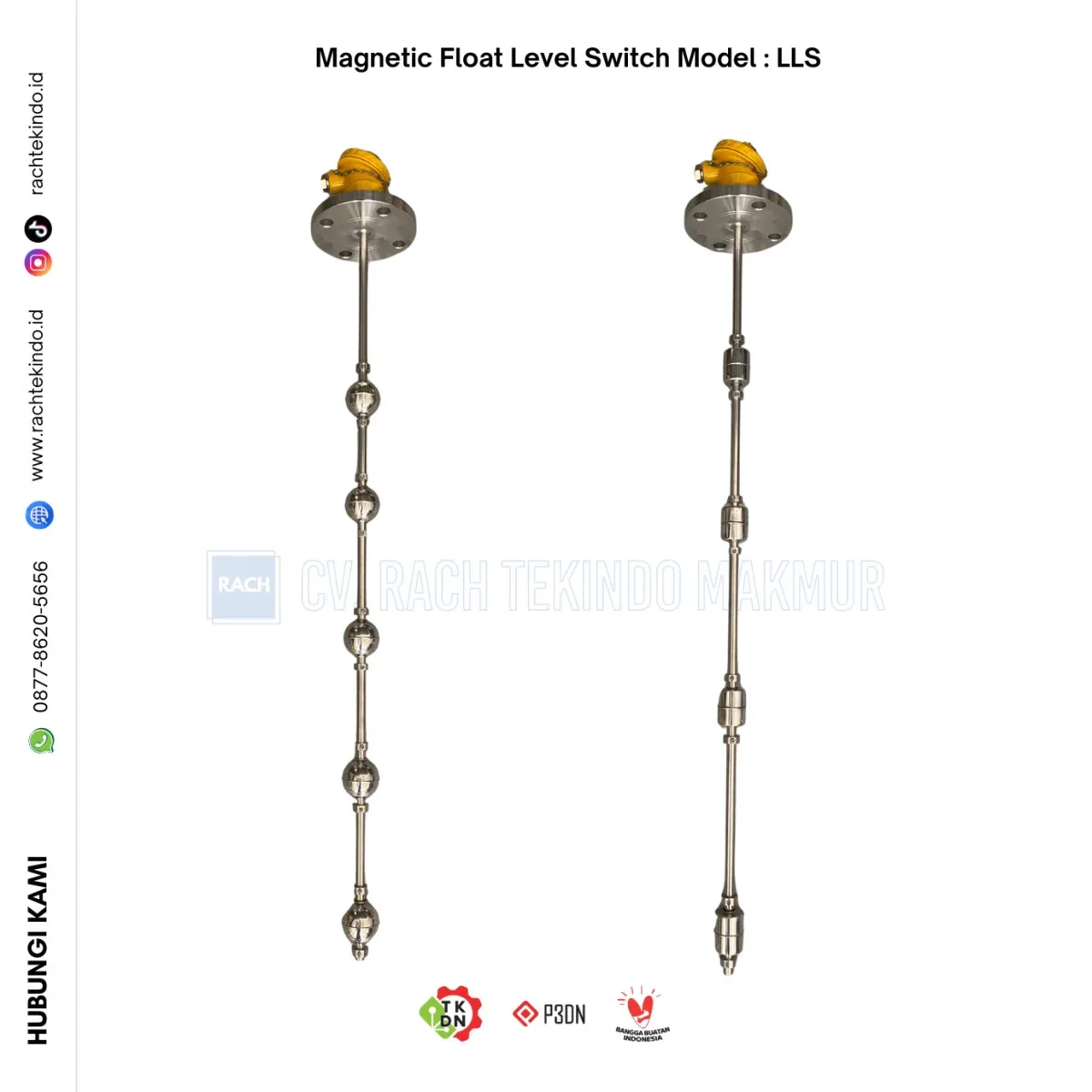
The Magnetic Float Level Switch Model LLS is available in single point and multi point configurations, with options for up to eight detection points. A single point arrangement can serve one function, such as a high level warning. A multi point arrangement can support several operating thresholds, provided the switching positions and control logic are specified for the process.
Available wetted material options include stainless steel 304 and stainless steel 316L. These choices allow the instrument to be considered for different liquid applications, but compatibility must be checked against actual operating conditions. Chemical concentration, temperature, and liquid density are relevant factors when selecting both the material and the float configuration.
Installation options include top mounting and side mounting, depending on the selected design. Process connections include threaded and flanged arrangements. The installation must provide sufficient clearance for float movement, with attention to tank walls, internal components, and deposits that could obstruct operation.
For industrial facilities looking for defined liquid level signals, the Model LLS offers several configuration options to review. Contact Rach Tekindo with the liquid type, tank dimensions, operating temperature, pressure, and required switching points to discuss a Magnetic Float Level Switch Model LLS suited to your application.
This article has been viewed 1 times.