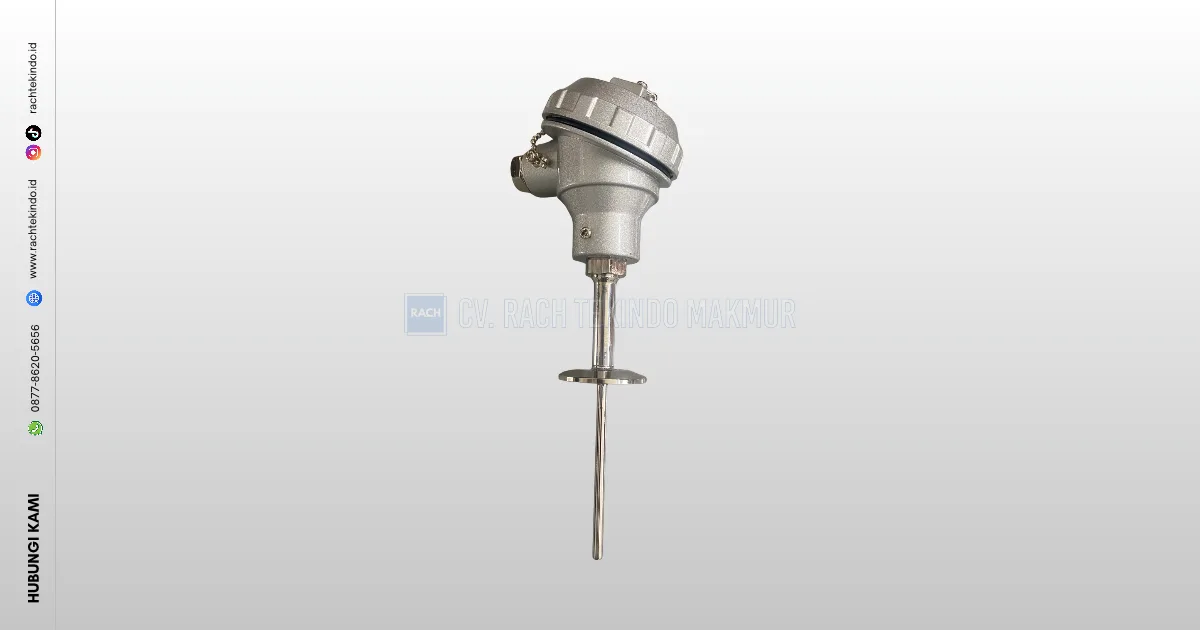
Selecting the right temperature sensor is important for reliable temperature measurement in industrial processes. Every application has different operating conditions, so a sensor that works well in one process may not necessarily be suitable for another.
Three commonly used temperature sensor types are RTD Pt100, Type K Thermocouple, and Thermistor. All three are designed to detect temperature changes, but they operate using different principles and have different characteristics.
RTD Pt100
An RTD, or Resistance Temperature Detector, measures temperature based on changes in electrical resistance caused by temperature variation. One of the most widely used industrial RTD types is the Pt100.
The name Pt100 refers to the platinum sensing element, which has a nominal resistance of 100 ohms at 0°C. As temperature changes, the resistance also changes, allowing the measurement system to determine the corresponding temperature.
Pt100 sensors are widely used in industrial temperature measurement and can be installed on pipes, tanks, machines, heat exchangers, boilers, and other process equipment.
Type K Thermocouple
Unlike an RTD, a Type K Thermocouple operates based on the thermoelectric effect. It uses two different metals that generate an electrical voltage when there is a temperature difference.
Type K is one of the commonly used thermocouple types in industrial temperature measurement. It can be applied to furnaces, ovens, machines, boilers, and other heating processes.
Its operating characteristics make it suitable for applications where thermoelectric temperature sensing is appropriate for the process conditions.
Thermistor
A thermistor also operates through changes in electrical resistance caused by temperature variation. However, its resistance characteristics are different from those of an RTD.
Thermistors generally provide high sensitivity to temperature changes within a specific range. Because of this characteristic, the sensor should be selected according to the required temperature range and application.
In industrial systems, thermistors can be used in applications where their specific resistance-temperature characteristics are suitable.
What Is the Difference Between Them?
The main difference between RTD Pt100, Type K Thermocouple, and Thermistor is their measurement principle and the type of signal generated.
RTD Pt100 measures changes in the resistance of a platinum element. A Type K Thermocouple generates a voltage through the thermoelectric effect, while a thermistor uses a specific resistance change in response to temperature.
Since each sensor operates differently, selection should not be based simply on which type is most commonly used. Process conditions, temperature range, measured medium, installation method, measurement requirements, and instrumentation system should all be considered.
RTD Pt100 or Thermocouple for Industrial Applications?
This is a common consideration when selecting a temperature sensor for industrial applications. There is no single sensor type that is suitable for every process.
RTD Pt100 can be selected when resistance-based temperature measurement is appropriate for the application. A thermocouple, meanwhile, may be suitable for processes where thermoelectric temperature sensing is preferred, including various heating applications.
For certain applications, a thermistor may also be suitable when its resistance-temperature characteristics match the measurement requirements.
Once the appropriate sensor type has been selected, its signal can be connected to a temperature transmitter when transmission to a control system is required.
The Role of a Temperature Transmitter
A temperature transmitter processes the signal from sensors such as RTD, thermocouple, or other compatible temperature sensors and converts it into an output that can be used by an industrial control system.
The 4–20 mA signal is widely used in industrial instrumentation. With a transmitter, temperature measurements can be transmitted to PLC, DCS, SCADA, and other monitoring systems.
The transmitter input must also be compatible with the selected sensor. For example, a transmitter for an RTD Pt100 must support the characteristics of the RTD input. The same principle applies to thermocouples and thermistors.
Selecting the Right Temperature Sensor
The selection between RTD Pt100, Type K Thermocouple, and Thermistor should be based on the overall application requirements. Process temperature, measured medium, installation location, control system, and required output are important factors when determining the appropriate configuration.
Selecting the right sensor from the beginning helps create a more stable temperature measurement system and makes integration with industrial control systems easier.
CV. Rach Tekindo Makmur provides Temperature Sensors & Temperature Transmitters for temperature measurement in various industrial applications. If you need RTD Pt100, Thermocouple, Thermistor, or a transmitter for PLC, DCS, and SCADA integration, contact us via WhatsApp at +62 877-8620-5656 to discuss your technical requirements and request a quotation based on the required configuration.