
Why Can't Electromagnetic Flow Meters Measure Diesel, Oil, LPG, or Gas?
By Admin
Read more
Accurate flow measurement is essential for improving efficiency, maintaining product quality, and reducing operational costs in industrial processes. One of the most widely used instruments for conductive liquid measurement is the Electromagnetic Flow Meter, also known as a Mag Flow Meter. This technology has become an industry standard because it delivers highly accurate flow measurement without any moving mechanical components.
Electromagnetic Flow Meters operate according to Faraday's Law of Electromagnetic Induction. As conductive liquid flows through a magnetic field, a voltage proportional to the flow velocity is generated. The transmitter converts this voltage into flow rate and total flow data, which can be displayed locally or transmitted to PLC, DCS, and SCADA systems.
One of the biggest advantages of an Electromagnetic Flow Meter is its no moving parts design. Unlike Turbine Flow Meters or Positive Displacement Flow Meters, there are no rotating components that wear over time. This significantly reduces maintenance costs while extending equipment life.
Another important benefit is the extremely low pressure loss. Since there are no obstructions inside the flow tube, pumping efficiency is improved and energy consumption can be reduced, especially in high-capacity pipeline systems.
Electromagnetic Flow Meters are ideal for clean water, wastewater, slurry, chemicals, acids, alkalis, pulp & paper, and many other conductive liquids. However, they are not suitable for non-conductive fluids such as pure oil, diesel fuel, LPG, LNG, air, or gases because these media do not generate the required electromagnetic signal.
Available in pipe sizes from DN10 to DN2000, with multiple liner materials, electrode options, and communication outputs including 4–20 mA, Pulse, RS485, and HART, Electromagnetic Flow Meters provide flexible solutions for modern industrial automation.
When selecting an Electromagnetic Flow Meter, engineers should evaluate liquid conductivity, pipe size, flow velocity, operating pressure, temperature, liner material, and electrode compatibility to ensure maximum performance and long-term reliability.
CV. Rach Tekindo Makmur supplies high-quality Electromagnetic Flow Meters for industrial applications throughout Indonesia. We provide engineering consultation, product selection, liner and electrode recommendations, compact or remote converter options, and complete integration support for PLC, DCS, and SCADA systems. Contact us via WhatsApp +62 877-8620-5656 for expert assistance and competitive quotations.
This article has been viewed 7 times.
By Admin
Read more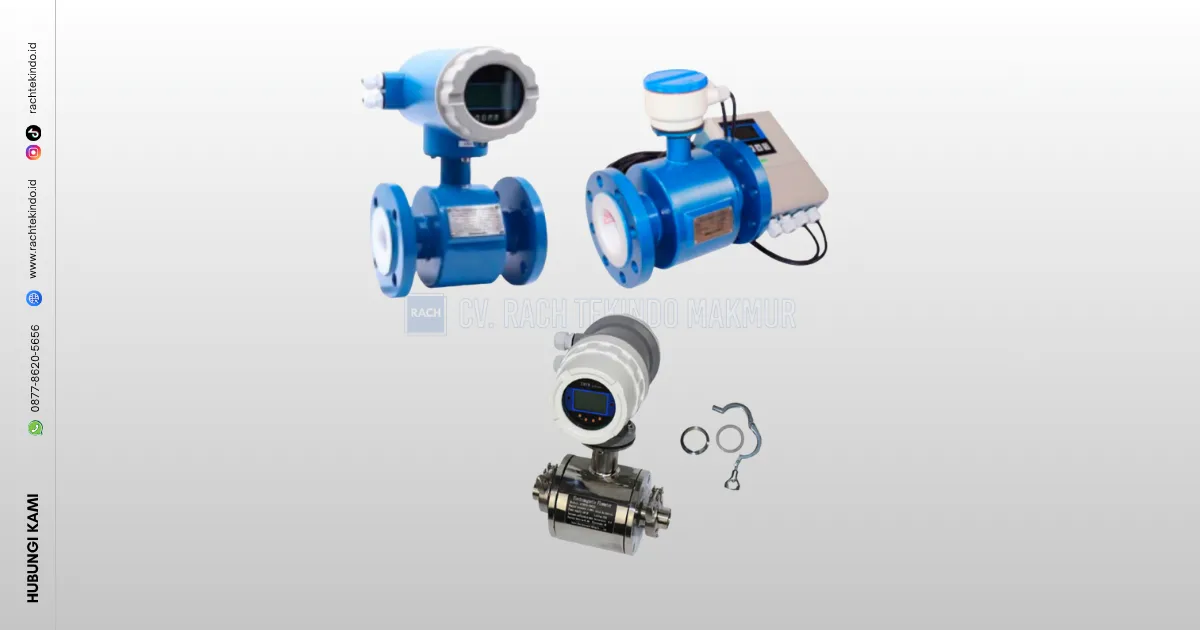
By Admin
Read more
By Admin
Read more